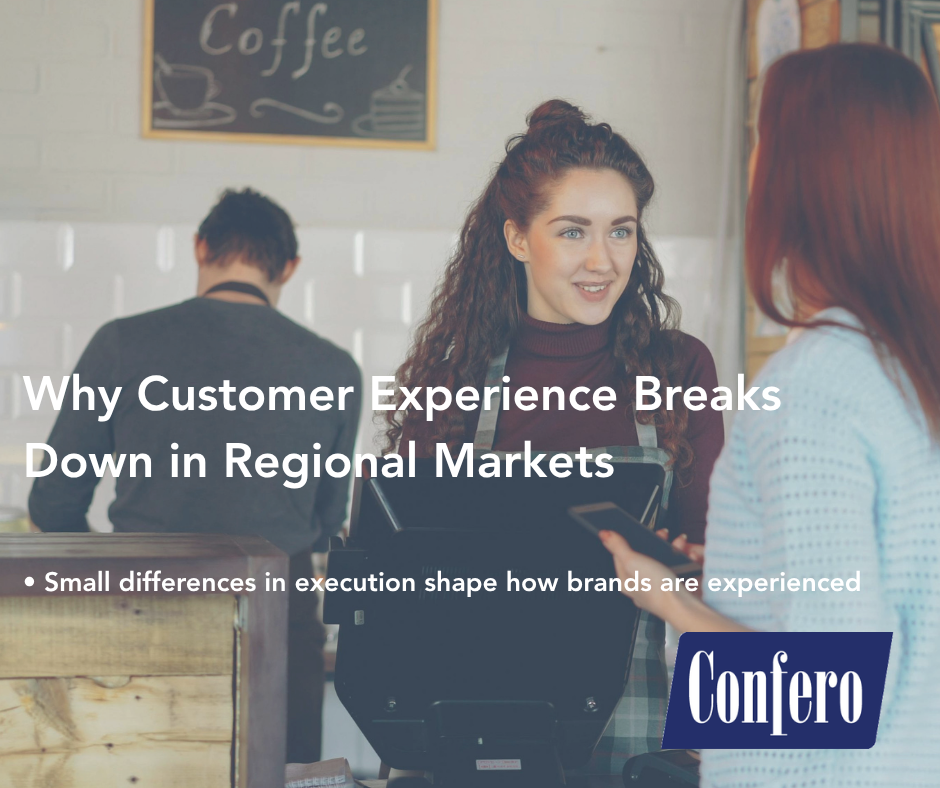
In many organizations, customer experience strategies are designed at a national level.
Standards are defined. Expectations are clear. Processes are documented.
On paper, everything aligns.
Yet in practice, the customer experience often varies significantly from one location to the next—especially in regional markets.
And when the experience varies, so does how customers perceive the brand.
What We’re Seeing Across Regional Locations
Across multi-location businesses, one pattern appears consistently:
The intended branded customer experience is not being consistently executed across regions.
In one location, service feels natural, attentive, and aligned with brand expectations. In another, the same interaction can feel scripted—mechanical—more like following a process than serving a customer.
Customers notice.
Not in a report. Not in a score.
In the moment.
When interactions feel overly structured, customers may feel like a number rather than a valued individual—often the opposite of what the brand intends.
Regional expectations add another layer.
What feels direct and efficient to a customer in the Northeast may come across as rushed or impersonal in the Southeast. What feels friendly and conversational in the Southeast may feel overly slow or indirect to customers in the Northeast.
Same brand. Same standards.
Different experience.
Over time, those differences shape how the brand is understood—and remembered.
The Disconnect Between Strategy, Execution, and Experience
Customer experience strategies are built for consistency.
Execution is not.
It happens in real time—under changing conditions, competing priorities, and human constraints.
And that’s where the breakdown begins.
Consider a common scenario:
A store is staffed with three employees. One steps away for a break. Now two people are managing both the floor and the register.
A line forms.
Interactions change.
Conversations shorten. Movements speed up. Employees begin moving through required steps or scripted questions just to keep pace.
Nothing is technically wrong.
The process is still being followed.
But the experience has shifted.
For customers, it feels repetitive and impersonal.
For employees, it feels rushed and reactive.
And for leadership?
It often remains invisible.
What was designed, what is executed, and what is experienced are no longer aligned.
Without objective human feedback, that gap is easy to miss—and difficult to diagnose.
Why Regional Markets Expose These Gaps
Regional markets don’t create inconsistency—but they reveal it.
Operations are often leaner. Teams are smaller. Adjustments happen locally and quickly.
There is less buffer.
And that changes everything.
In smaller locations, leadership influence is amplified.
With fewer team members, store managers and local leaders shape the experience more directly. Their communication style, expectations, and approach to training show up immediately in how service is delivered.
In larger metro locations, layers of leadership and support can stabilize execution. In regional markets, that structure is often thinner.
Which means differences—good or bad—are more visible.
Regional behavior also plays a role.
Customer expectations are not identical across markets. What feels efficient in one region may feel abrupt in another. What feels personable in one area may feel inefficient in another.
These differences don’t change the strategy.
But they absolutely change how the experience is delivered—and how it is perceived.
The Business Impact of Inconsistent Experience
When customer experience varies across locations, the impact isn’t just operational.
It’s perceptual.
And perception is what customers act on.
• Brand perception
• Customer trust
• Repeat business
• Long-term loyalty
Customers don’t evaluate brands based on strategy.
They evaluate them based on experience.
And they expect that experience to be consistent.
When it isn’t, confidence erodes—often quietly.
The cost of retaining customers versus acquiring new ones is well understood.
But by the time changes show up in sales data, the underlying experience issues have usually been present for some time.
Customers who feel overlooked or undervalued don’t wait for a report.
They adjust their behavior.
They disengage.
– They look elsewhere.
And often, they do so before the business recognizes the shift.
Which raises a critical point:
Customer experience breakdowns are rarely sudden.
They are gradual—and often invisible until they become measurable.
That’s why a reactive approach is not enough.
Where Insight Becomes Critical
Most organizations have data.
Sales data. Performance metrics. Customer feedback.
But data alone does not explain experience.
When organizations rely primarily on standardized metrics, the human element can be lost. These measures can show what is happening—but not how it is happening.
At best, they function like a required customer survey:
Structured. Consistent.
But limited in context.
Customer feedback adds perspective—it reveals how customers feel.
But even that has limits.
It rarely explains why the experience unfolded the way it did.
This is where objective human feedback becomes essential.
Through mystery shopping and observational research, organizations can see what is actually happening during real interactions.
Not reported.
Not summarized.
Observed.
Together, these perspectives create clarity:
• perception shows how the experience is received
• observation shows how it is delivered
And that combination is what turns information into insight.
Turning Insight Into Action
When organizations can clearly connect execution, experience, and perception, they gain something powerful:
Visibility.
They can see where breakdowns occur.
Understand how those breakdowns affect customers.
And take action that aligns operations with brand expectations.
This is where insight becomes actionable.
Closing the Gap Across Regional Markets
Customer experience does not break down randomly.
It breaks down where visibility is limited.
And it improves when organizations understand not just what is happening—but how and why it is happening.
Combining customer feedback with objective human observation creates that understanding.
It allows organizations to:
• support frontline teams more effectively
• improve consistency across locations
• strengthen alignment between strategy and execution
Consistency isn’t created through strategy alone.
It’s built through visibility, understanding, and continuous adjustment.
👉 These challenges are especially visible in multi-location retail and grocery environments, where consistency across locations directly impacts customer perception.