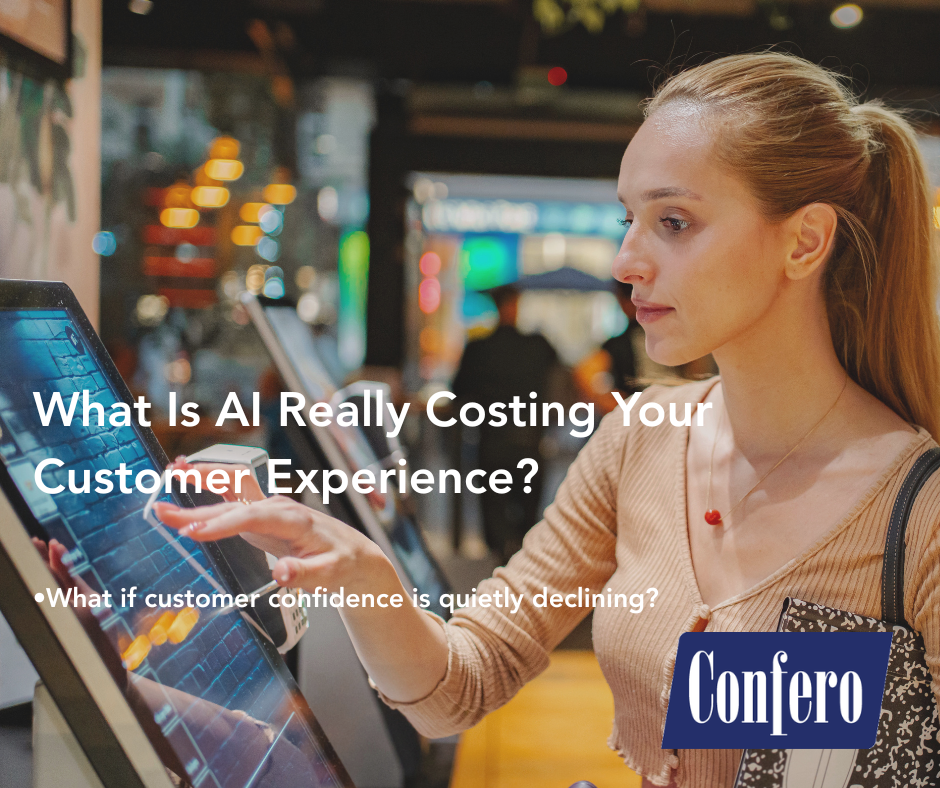
What happens when automation improves performance metrics while customer confidence quietly declines?
Organizations everywhere are investing in artificial intelligence.
The promised benefits are compelling.
Faster responses.
Lower operating costs.
Greater efficiency.
Improved scalability.
But what happens when customers leave interactions feeling less confident than before they started?
That question may become increasingly important as AI becomes more deeply integrated into customer experiences.
When Success Metrics Tell Only Part of the Story
Many organizations evaluate AI success through operational measurements.
They monitor:
- response times
- automation rates
- containment rates
- labor savings
Those metrics matter.
However, they do not always reveal how customers actually experience those interactions.
A customer may receive an answer immediately.
The chatbot may successfully complete its assigned task.
The dashboard may record the interaction as a success.
Yet the customer may still walk away wondering:
Was that information accurate?
Can I trust that answer?
Should I double-check it somewhere else?
Did that response actually address my issue?
Why can’t I speak with someone who can solve my problem?
In some cases, customers may begin to feel devalued when they are routed through one automated interaction after another without reaching a person capable of helping them. This can occur in the store, on the phone, in your app or on your website and all matter to your ongoing long-term success.
Those questions and customer reactions rarely appear on operational dashboards.
Yet they directly influence customer confidence, trust, and long-term loyalty.
Invisible Issues That Cost Businesses Customer Loyalty
Much of the discussion surrounding AI focuses on obvious mistakes.
Hallucinations.
Incorrect answers.
Public failures.
Embarrassing headlines.
Those risks are real.
However, the larger challenge may be far less visible.
Customers do not always know when information is incomplete, misleading, or inaccurate.
Employees may not recognize it either.
AI systems can deliver answers confidently even when those answers are flawed.
At the same time, organizations may unknowingly create interactions that feel cold, impersonal, or disconnected from the customer’s actual need.
As those interactions accumulate, organizations may create small moments of doubt that slowly erode trust.
Unlike a website outage or product failure, these problems often occur quietly.
There is no alarm.
No flashing warning light.
Only customers becoming less confident over time and eventually beginning to explore alternatives.
Technology Can Work Exactly As Designed
One of the most common assumptions in technology projects is that technical success automatically creates customer success.
Real-world customer experiences often tell a different story.
A system may function perfectly.
The implementation may meet every project requirement.
The reporting may show positive results.
Yet customers may still experience:
- confusion
- frustration
- uncertainty
- additional effort
Technology can perform exactly as intended while customer experience suffers.
That gap is where many organizations encounter operational friction.
It is also where organizations often discover the difference between efficiency and loyalty.
Measuring More Than Efficiency
As AI adoption accelerates, organizations may need to ask different questions.
Not simply:
Is the technology working?
But:
How are customers experiencing the technology?
Not simply:
How many interactions were automated?
But:
Did those interactions strengthen or weaken customer confidence?
Not simply:
Did we reduce costs?
But:
What impact did those savings have on customer trust?
Not simply:
Did the customer receive an answer?
But:
Did the customer feel helped?
These are customer experience questions.
And they are becoming increasingly important business questions.
Why Validation Matters
Technology reveals what happened.
Customer experience research helps explain why it happened.
Quantitative data may identify patterns.
Qualitative insight helps organizations understand the customer reality behind those patterns.
Together, they help leaders identify gaps between intended experiences and actual experiences.
That visibility becomes especially valuable when emerging technologies are influencing customer interactions at scale.
Organizations that measure only efficiency may miss emerging customer frustration.
Organizations that validate customer experiences gain the visibility needed to identify problems before they become loyalty, reputation, or revenue challenges.
Final Thought
Most organizations are asking how much AI can save.
A more important question may be:
What is AI costing customer confidence?
The organizations that benefit most from AI will likely be those that measure more than efficiency.
They will measure trust.
Confidence.
Consistency.
And the real-world customer experience created by every interaction.
Because customers do not experience technology.
They experience the results technology creates.